If you are thinking about hiring an investigator, the first question is rarely “who is available?” It is usually “who can I trust with this?” Online searches turn up dozens of agencies, many calling themselves the best or the number one, and those claims are hard to verify.
Knowing how to choose a detective agency in Delhi comes down to asking the right questions before you share details or pay anything. A good agency can explain what it will do, how it will protect your privacy, what you will receive at the end, and what it cannot promise.
This guide gives you a practical 10-question checklist, along with red flags, cost and timeline guidance, and a simple way to compare two or three agencies side by side.
Why Choosing the Right Detective Agency Matters
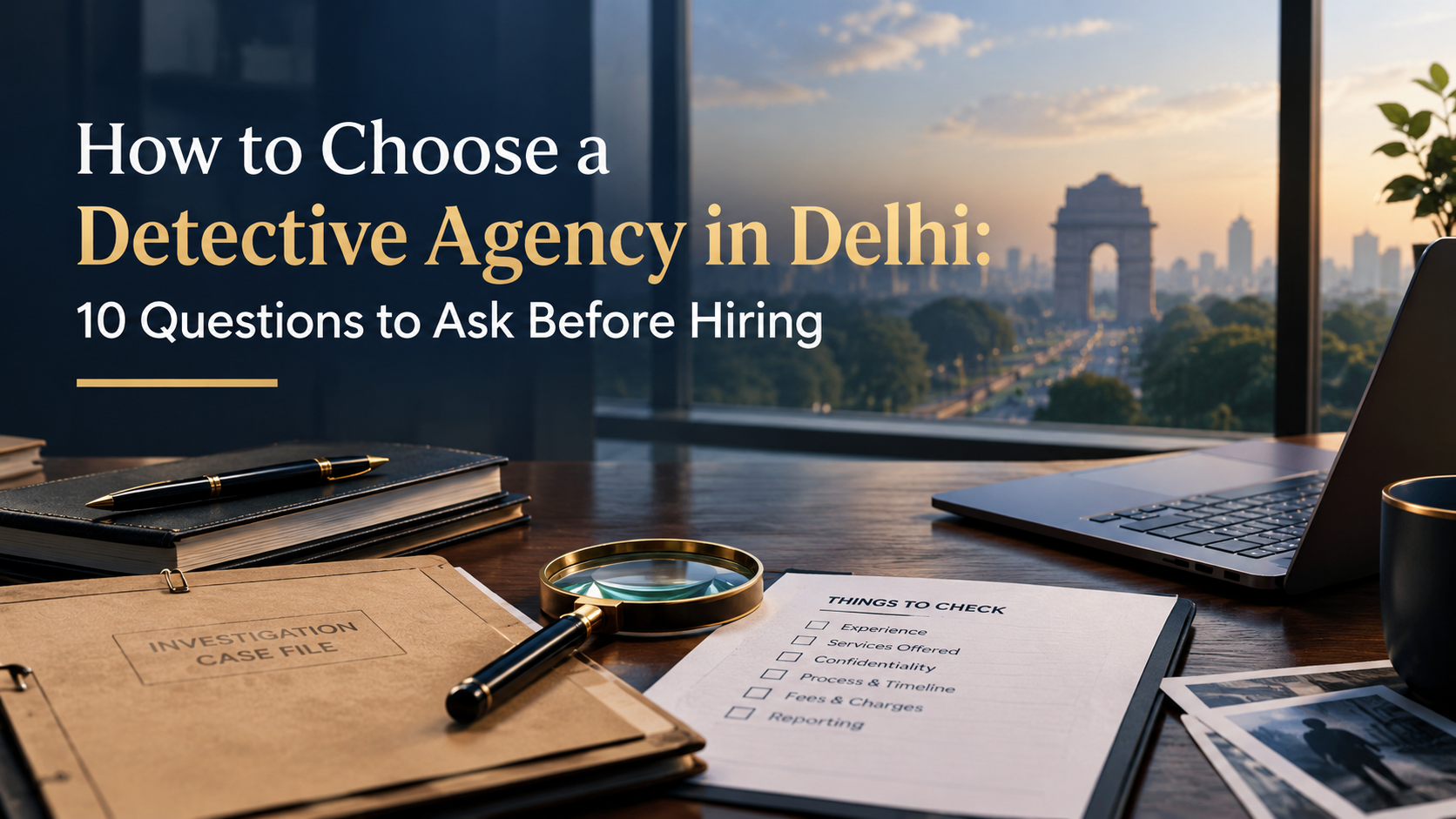
Most people hire an investigator during a stressful time: a marriage decision, a suspected breach of trust, a workplace concern or a missing relative. You may be sharing names, photographs, addresses and personal history, so privacy matters from the first call.
Time and money matter too. An investigation with a vague scope can drift, and a report that cannot be explained or relied on is of little use to you.
The method matters as well. Information gathered unlawfully can create legal trouble for the client, not just the agency. Careful selection protects your privacy, your budget and your position.
How to Choose a Detective Agency in Delhi
The process is simpler than it looks. Start by defining your own need: what you want to know, why, and what you plan to do with the answer. An agency can only scope the work properly if you can describe the problem.
Next, shortlist two or three agencies and speak to each directly. Use the ten questions below as your script. Compare answers rather than sales language. Finally, put the agreed scope, fees and reporting format in writing before work begins.
An agency that answers clearly, admits limits and does not rush you is usually a better sign than one with the boldest marketing.
10 Questions to Ask Before Hiring a Detective Agency
1. What type of investigation does the agency handle?
Investigation work is varied. Pre-matrimonial checks, corporate due diligence and missing person cases need different skills and different approaches. An agency that claims to do everything equally well deserves a follow-up question.
A reasonable answer names the categories the agency regularly handles and says plainly when a case falls outside them. Ask which team members would work on yours.
2. Have they handled cases similar to yours?
Relevant experience shortens the learning curve. It also helps the agency anticipate obstacles you have not thought of.
Ask for a general description of the kind of cases handled, not client names. A trustworthy agency will not share confidential details, and you should be wary of one that does. Be cautious of impressive-sounding numbers with nothing behind them.
3. How will the investigation be planned?
A professional agency should be able to outline its approach before starting: what needs to be established, what sources and methods are likely, and what stages the work will go through.
You are not asking for trade secrets. You are checking that there is a plan rather than improvisation. If the answer is only “we will find out everything”, ask what that means in practice.
4. How is client confidentiality maintained?
Confidentiality should be explained, not just promised. Ask who will have access to your case information, how documents are stored and shared, and whether a written confidentiality agreement is offered.
Also ask how the agency handles contact. For example, will calls and messages go to a number or email you choose? Discretion around how you are contacted can matter as much as discretion inside the file.
5. What information or documents will the client need to provide?
Useful investigations start with good inputs, such as names, addresses, dates, photographs or relevant documents. A good agency will tell you exactly what it needs and why.
Be careful if an agency asks for far more than the task requires, such as banking passwords, account logins or ID documents unrelated to the case. Share only what the scope needs.
6. What type of evidence or report will be provided?
Ask what you will actually receive: a written report, photographs, dated observations, verification records or a verbal summary. The format should match your purpose. If you may need the findings for a formal or legal process, say so early.
A sound answer explains what the report will contain and distinguishes verified facts from the investigator’s observations or assumptions. For legal use, ask your lawyer what form of documentation will be useful.
7. How long might the investigation take?
Duration depends on the case type, the availability of information and the activity involved. A background check and a surveillance assignment will not follow the same timeline.
Expect a range with the factors that could change it, not a fixed promise. A good agency will also tell you what happens if the work needs more time.
8. How are investigation fees and expenses explained?
Ask whether the fee is fixed, hourly, daily or stage-based, and what is included. Clarify separately how travel, extra personnel and other expenses will be handled.
A transparent agency can explain what drives the cost and will confirm the terms in writing. Be wary of vague totals that grow once work has started.
9. How will communication and progress updates work?
You should know who your point of contact is, how often you will hear from them and through which channel. Some cases need regular updates, while others are better reported at defined milestones.
Also ask what happens if something significant emerges mid-way. A good agency will want to check the scope with you rather than quietly expand it.
10. What methods and investigative practices will be used?
This question separates professionals from risky operators. Investigators can legitimately rely on lawful means such as public record checks, field verification, interviews and observation conducted within the law.
Be cautious if an agency suggests obtaining call records, bank details, private messages or account access through unofficial routes. Such methods may be unlawful, and the consequences can reach you as the client. A good agency will say clearly what it will not do.
Types of Investigation Services You May Need
The right agency depends on what you need investigated. These are the common categories:
- Pre-matrimonial verification: checking background, education, employment and family details before a marriage decision.
- Post-matrimonial investigation: fact-finding when there are genuine concerns within an existing marriage.
- Background and employee verification: confirming identity, past employment, qualifications and references for hiring decisions.
- Corporate investigation: workplace misconduct, vendor checks and internal concerns.
- Due diligence: reviewing a business, partner or counterparty before a deal.
- Asset verification: confirming ownership or details of declared assets.
- Surveillance: lawful observation to document activities relevant to a matter.
- Missing person investigation: tracing and locating individuals, often alongside the police and family.
If your case is matrimonial, our guide on matrimonial investigation in Delhi explains what to know before marriage. For business and hiring needs, read about corporate investigation and background verification.
What to Look for in a Professional Detective Agency
Beyond the ten questions, a few qualities tend to show up in agencies worth considering:
- Clear communication: they listen first, ask relevant questions and explain things in plain language.
- Confidentiality practices: they can describe how your information is protected.
- Relevant experience: their work matches the type of case you have.
- Transparent scope: deliverables, limits and assumptions are written down.
- Realistic timelines: they give ranges and explain the variables.
- Documentation: you will receive findings in a usable format.
- Professional conduct: they are punctual, respectful and not pushy.
- Lawful methods: they stay within the law and decline requests that do not.
You can also ask for basic business details such as registered business name, office address and contact information. These do not prove quality, but they help you confirm you are dealing with a real, reachable business.
Red Flags to Watch for Before Hiring
Most agencies will not show every warning sign, but any of these is worth pausing over:
- Guaranteed outcomes. No investigator can honestly promise what they will find.
- Unrealistic claims. Instant results or access to “any” information should raise questions.
- Unclear pricing. A reluctance to explain how fees work is a concern.
- Pressure to pay immediately. Urgency used to skip your questions is a poor sign.
- Vague methods. If they cannot say how they work, you cannot judge whether it is lawful.
- Refusal to define the scope. You should know what you are paying for.
- Exaggerated “No. 1” or “100% guaranteed” claims. Ratings and rankings are often self-declared.
- Requests for unnecessary sensitive information. Share only what the case needs.
One red flag does not always mean bad intent, but several together are a good reason to look elsewhere.
How Much Does a Detective Agency in Delhi Cost?
There is no single standard price, and a quote given without knowing your case should be treated cautiously. Costs usually depend on:
- the type of investigation
- how long it runs
- the location or locations involved
- the number of investigators needed
- whether surveillance is required
- travel requirements
- how complex or difficult the case is
- the level of reporting you need
For example, a basic verification and a multi-day field assignment involve very different effort. A genuine quote usually follows a conversation about scope. Ask for the fee structure and expense terms in writing before you agree, and ask what would trigger additional charges.
How Long Does a Private Investigation Take?
It varies. Straightforward verification may need less time than an investigation involving several locations, hard-to-reach people or limited starting information.
Factors that affect duration include the type of case, the information you can provide, how available the relevant records or individuals are, and whether surveillance is involved. A responsible agency will give you an expected range, tell you what could extend it, and not promise a specific result by a specific date.
How to Compare Two or Three Detective Agencies
After your conversations, put the answers side by side. This is a note-taking tool for you, not a ranking:
| Factor | Agency A | Agency B | Agency C |
|---|---|---|---|
| Relevant experience | |||
| Case type handled | |||
| Confidentiality process | |||
| Investigation scope | |||
| Communication plan | |||
| Reporting format | |||
| Timeline estimate | |||
| Fee clarity |
Look for the agency whose answers are clearest and most consistent, not simply the lowest price or the most confident tone.
Comparison of Detective Agencies in Delhi
If you are comparing different agencies, this comparison of 5 detective agencies in Delhi can help you understand the services, areas of investigation, and factors worth considering before making a decision. Use it alongside the checklist above to test any agency’s answers against your own needs.
Frequently Asked Questions
How do I choose a reliable detective agency in Delhi?
Define your need, shortlist two or three agencies, and ask each the same set of questions about experience, confidentiality, methods, fees and reporting. Prefer the one that explains clearly, sets a written scope and makes no guarantees.
What should I ask a private detective before hiring?
Ask what cases they handle, how they plan the work, how they protect confidentiality, what you will receive, how long it may take, how fees work and what methods they use.
How much does a private detective cost in Delhi?
It depends on the case type, duration, location, number of investigators, travel and reporting needs. A reliable quote follows a discussion of your case, so be careful with fixed prices quoted without one.
How long does a private investigation take?
Timelines vary by case. Ask for an estimated range and the factors that could change it, and be cautious of firm promises.
Are detective investigations confidential?
They should be handled confidentially, but confirm how. Ask about who has access to your information, how it is stored and whether a written confidentiality agreement is available.
What information should I provide to a detective agency?
Share what the case needs, such as names, addresses, photographs and relevant documents. Do not share passwords, banking credentials or unrelated ID documents.
Can a detective agency provide an investigation report?
Most agencies provide a written report. Ask in advance what it will include and whether it separates verified facts from observations, especially if you may need it for a formal process.
What should I do if an agency guarantees a specific result?
Treat it as a warning sign. Ethical investigators can describe their approach but cannot guarantee findings. Ask them to explain the claim, and consider other agencies if they cannot.
Final Checklist Before Hiring
☐ The agency understands my case
☐ The investigation scope is clear
☐ Confidentiality has been explained
☐ The communication process is clear
☐ The timeline has been discussed
☐ Fees and expenses are explained
☐ Reporting and evidence expectations are clear
☐ The proposed methods are appropriate
☐ No unrealistic guarantees were made
Conclusion
Knowing how to choose a detective agency in Delhi means judging how an agency works, not how loudly it advertises. Clear scope, explained fees, practical confidentiality and lawful methods tell you far more than a “No. 1” label.
Take your time, compare more than one agency, and get the terms in writing. If you would like to talk through your situation before deciding, Apex Detective Agency can discuss your requirements and explain how it would approach the work.